
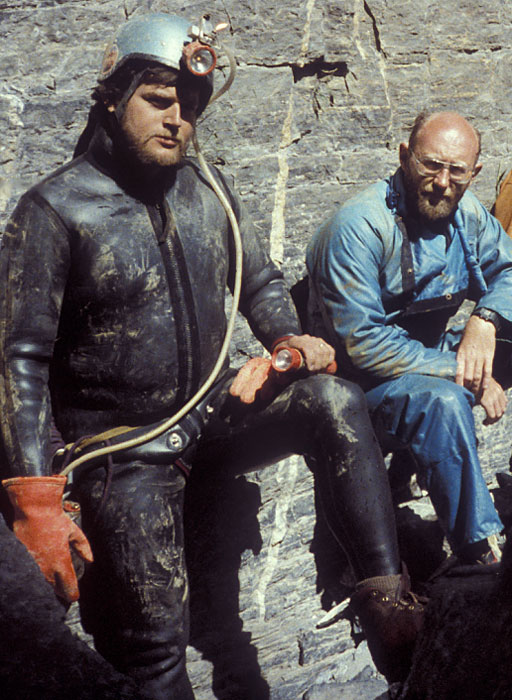
In 1968, only Canyon Creek Ice Cave and Cadomin Cave were known to the club, and only Canyon Creek had been visited by any of the members. Although cavers from McMaster University (Hamilton, Ontario) had held summer field camps in the Rockies since 1965, most of their work had been independent of the Alberta Speleological Society activities until 1971 when there was some participation on trips organized by the McMaster University Caving and Climbing Club. These McMaster cavers spearheaded many of the “big” Rockies explorations between 1967 and 1973, including Castleguard Cave, Yorkshire Pot, Gargantua and Arctomys Cave. Throughout the 70s many of the key cavers in this group moved west and joined the Alberta Speleological Society, and this influx of primarily ex-British talent and energy became a defining element in the club’s attitudes and abilities, resulting in a blend of American and European caving styles.
The mid-1970s witnessed a slowdown of caving in the Rockies, with modest discoveries being made by one or two keen individuals and some important participation by members on Vancouver Island explorations. Perhaps the cream of Rockies caves had been taken, but this period may have reflected a loss of personal energy as well.
Another ballooning of activity occurred between 1980 and 1988, partially because of a willingness to use helicopters to open up remote caving areas, partially as a spin-off of a succession of British expeditions to the Rockies, and partially the result of a new wave of energetic novices. This period began with important new discoveries at Crowsnest Pass, most of which have since connected with Yorkshire Pot. Other discoveries and explorations included Fang Cave, Porcupine Cave, White Hole, Dezaiko Cave and Moon River Cave, all in the north and central Rockies and many of which ended up on the 'top ten' of Canada’s ‘longest and deepest list at the time. As well, Alberta Speleological Society cavers were the first to document caves on the Queen Charlotte Islands, and participated in the exploration of some of the deepest caves on Vancouver Island. This busy period ended on a high note with the ‘bottoming’ of a 254m deep shaft in Close To The Edge, thought at that time to be one of the 50 deepest shafts in the world.
In the 1990s activity again dropped off dramatically, perhaps the result of the aging or retirement of key cavers, but there has been a burst of activity in the new millenium. Close To The Edge was revisited and deepened to 470m, now the third deepest in Canada, and Lost Light Cave has become the longest cave within Jasper National Park. But in contrast to the 1980s, it is the southernmost areas of the Canadian Rockies that have received the most attention, including exploration of the vertical Ptarmigan Cave (over 300m deep), Pellet Factory with its metres-deep packrat poo and wind-sculpted ice formations, the voluminous passages of River-Gone Dream Cave, and the self-describing Thin Man's Temptation.
Many new caves have recently been discovered and explored in the Fernie area, a number of which are over 250m deep. In 2010, after more than five years of effort including an unsuccessful dig, A.S.S. cavers discovered a connection passage between Heavy Breather and Pachidream, breaking a long-standing Canadian depth record and establishing the combined system at 655 meters. However, this depth record was soon broken again in 2018, at Bisaro Anima, a new discovery made via helicopter access on the Mt. Bisaro Plateau. The last few meters of this 670 meter deep system were achieved by means of a sump dive executed by our president, Kathleen Graham.
Other recent exploration and research expedition work involving key contributions by A.S.S. members has taken place at White Rabbit in the Monashee Mountains of BC, Raspberry Rising in Glacier National Park, a scientific study of the ice caves atop volcanic Mt. Ranier and Mt. St. Helens in Washington State, and both re-survey and sump dive exploration activity in Castleguard, Canada's longest cave . The expedition - level cavers in our Society have proudly maintained an international reputation which was first established decades ago. For the future, the potential for new Rockies discoveries or for extension of known systems remains high for cavers with the requisite time and energy.
Cavers like travelling with their sport. Alberta Speleological Society members have initiated or participated on caving trips or expeditions to Alaska, Australia, Belize, Bolivia, China, Costa Rica, Cuba, the Dominican Republic, England, France, Guatemala, Haiti, Hawaii, Hungary, India, Ireland, Jamaica, Japan, Mexico, New Guinea, New Zealand, Norway, Peru, Sardinia, Wales and the continental USA. A few Alberta Speleological Society members have moved overseas and have reported explorations in Australia, Bhutan, the Cook Islands, Indonesia and Japan in our newsletter.
For a copy of the Castleguard Cave survey, go to this page.